Represent the lifecycle
Property qualification, project coordination and reporting have distinct purposes, connected by the context needed at each stage.
 ELGAALIINVESTMENT GROUP
Selected work · Electric mobility
Software for the work behind EV charging projects.
An application connecting property qualification, project coordination, client workspaces, and reporting for an EV-charging operation.
Preview EVRVA (opens in a new tab)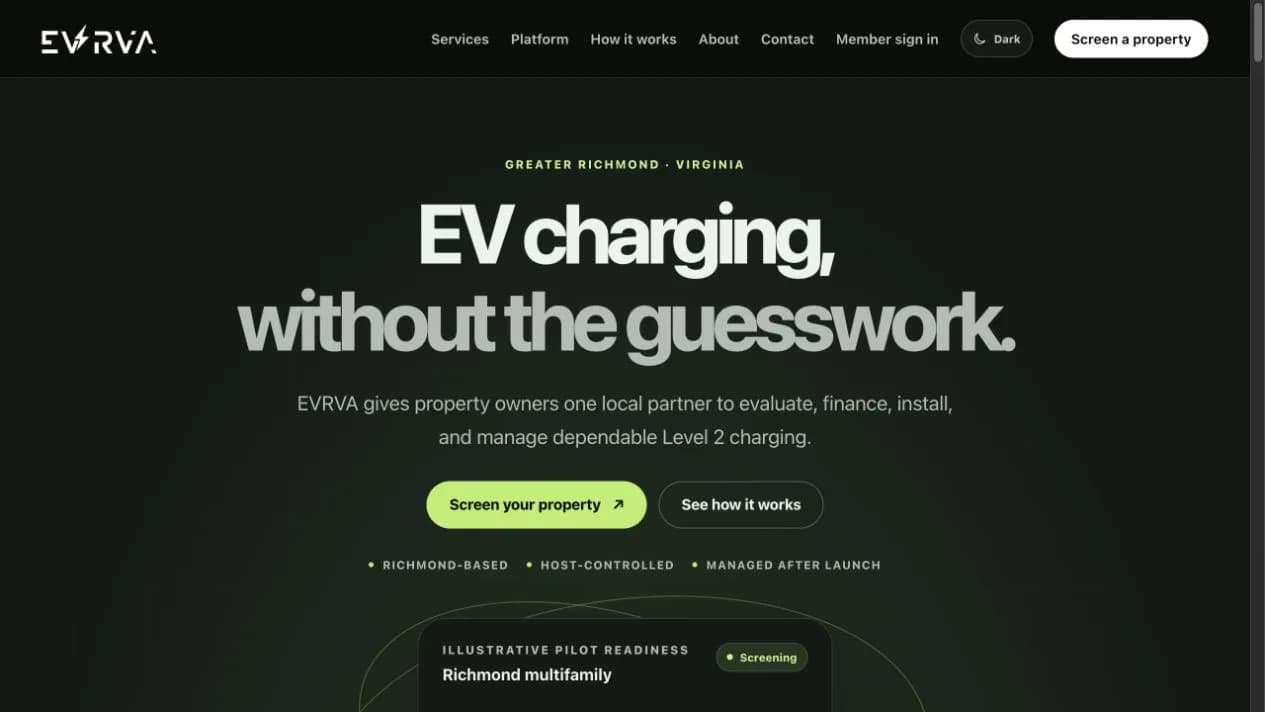
The context
An EV-charging project spans property screening, delivery decisions, documentation, and ongoing operations. Each stage needs context and a clear definition of what comes next.
EVRVA organizes that lifecycle into purpose-built workflows, bringing qualification, project visibility, and client reporting into a connected application.
Explore the approach
EVRVA · Capability overview
A structured property pipeline records readiness, priorities, follow-up dates, and blockers.
An explanation of the application’s design. Protected workflows require authorized access; this overview does not demonstrate live customer activity.
From the workflow to the interface
Property qualification, project coordination and reporting have distinct purposes, connected by the context needed at each stage.
A visible project stage provides context; it does not by itself prove a property is qualified, delivery is complete or a service is certified.
A structured property pipeline records readiness, priorities, follow-up dates, and blockers.
Operational workspaces organize project stages, responsibilities, and supporting records.
Dedicated client-facing workspaces and reviewed reports connect delivery with ongoing service.
The design principle
Apply the thinking to your business
For a business coordinating projects across several people, an assessment can map decision points, surface missing inputs, and define who owns the next review.
Agree a baseline for incomplete review inputs and time spent preparing a project update, then compare equivalent work after delivery. These are proposed measures, not reported results.
Discuss a workflow assessmentThe public preview opens in a separate tab. Protected features require authorized sign-in on that site. This overview describes application capabilities, not measured customer or revenue results.
A different business. The same thoughtful approach.
A little direction
Choose a starting point. See what’s included, then talk directly with Omar about the fit.
$300introductory fixed scope
One reproducible React, Next.js or JavaScript defect, up to four delivery hours, a regression check and handover notes. We confirm fit before agreeing the work.
Excludes authentication, payments, migrations and incident response. Larger fixes need a new scope.
Describe your repair